For decades, Donald Knuth's TeX and Leslie Lamport's LaTeX have stood as the undisputed gold standard for mathematical typesetting, peer-reviewed scientific publishing, and complex technical typography. Yet for all its typographic elegance, traditional desktop LaTeX was notoriously burdened by brutal installation overhead, fragile package dependencies, and fragmented collaboration rituals. The emergence of ScribTex in 2008—pioneered by James Allen and later evolving into ShareLaTeX and modern Overleaf—sparked an architectural revolution, demonstrating how containerized server execution and browser-based interfaces could liberate demanding desktop toolchains into the cloud.
The Friction of Traditional Desktop Typesetting
To appreciate the breakthrough that ScribTex represented, one must examine the workflow hurdles that plagued researchers, university faculties, and technical authors for decades. Authoring a technical paper locally required downloading massive TeX distributions like TeX Live or MiKTeX, frequently consuming upwards of five to ten gigabytes of disk storage. Even with a full distribution installed, authors routinely encountered missing style sheets (.sty files), incompatible font definitions, or outdated CTAN (Comprehensive TeX Archive Network) packages.
Furthermore, academic research is inherently collaborative. Co-authors distributed across international universities faced a logistical nightmare. Drafts were emailed back and forth as zipped bundles containing .tex source files, BibTeX bibliographies (.bib), and vector figures (.eps, .pdf). Merge conflicts were reconciled manually by pasting paragraphs across text editors. If one collaborator ran a different compiler version—or lacked a specific macro package installed on the lead author's machine—the compilation failed with cryptic TeX trace errors. Scientific momentum was routinely derailed by trivial environmental discrepancies.
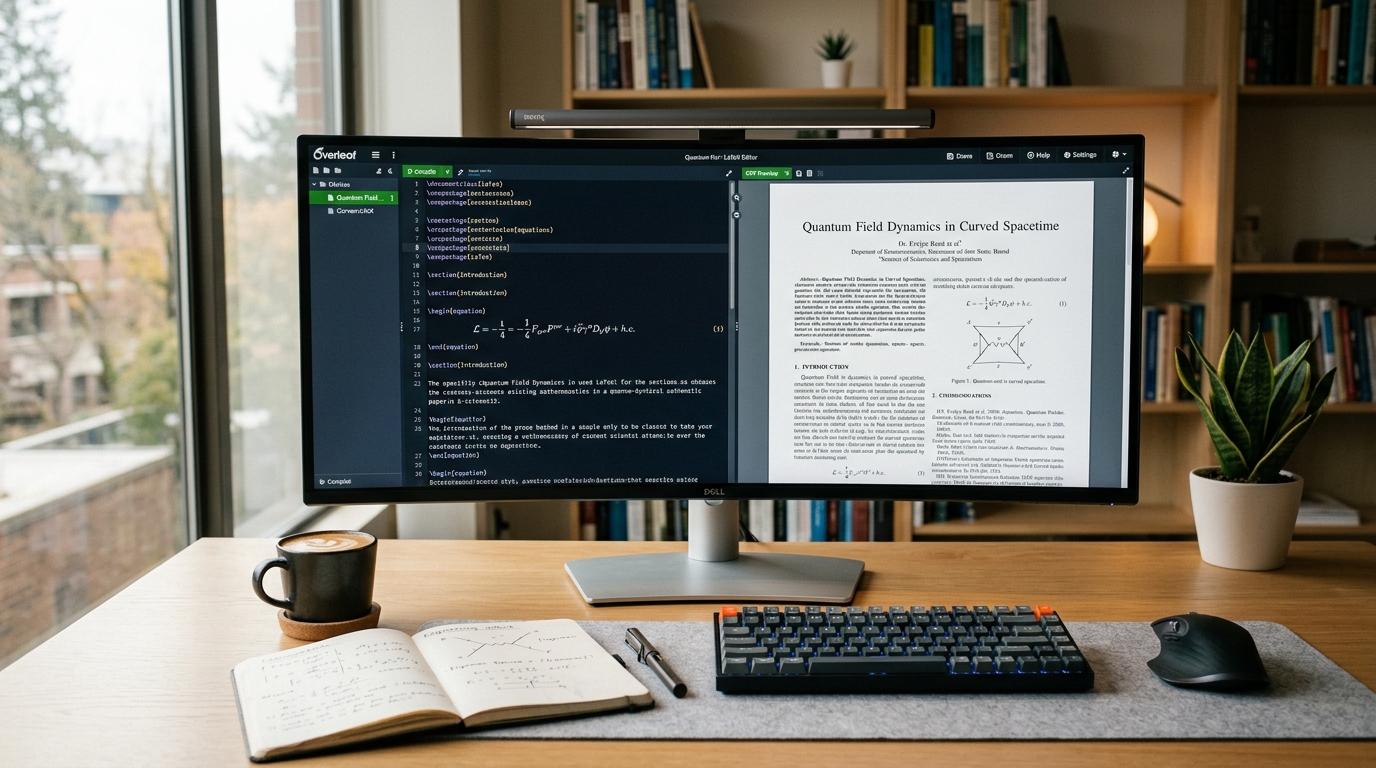
The Cloud Architecture: Solving the Compiler Sandboxing Challenge
Transitioning LaTeX compilation into a multi-tenant cloud environment was an imposing systems engineering problem. The classic TeX engine was designed in an era when compilers executed on trusted local mainframes or single-user desktop workstations. By default, TeX engines included features like \write18, which allows arbitrary shell command execution from within the document markup to invoke external plotting tools or graphics preprocessors. In an unconstrained shared web server, allowing arbitrary users to upload and compile TeX code would allow trivial remote code execution (RCE) and system compromise.
ScribTex and its architectural successors solved this by engineering hardened containerized sandboxes:
- Compiler Isolation: Every document compilation is executed inside an ephemeral, tightly constrained sandbox (initially using Linux chroot jails and control groups, and later container technologies like Docker). Network egress is disabled during compilation to prevent exfiltration or botnet communication.
- Shell Escape Disablement: TeX engines are executed with strict
--no-shell-escapeflags, preventing malicious documents from executing shell binaries while maintaining safe typographic rendering. - Resource Limits and Quotas: Strict memory, process count, and CPU execution time limits (such as a 60-second compilation ceiling) prevent infinite recursive macro expansion loops (such as accidental runaway
\defcycles) from starving server resources. - Shared Read-Only CTAN Trees: Rather than duplicating multi-gigabyte TeX distributions per user, the underlying hosting cluster mounts a read-only, fully updated TeX Live tree across all worker nodes, ensuring 100% package availability without local storage costs.
Evolutionary Path: From ScribTex to ShareLaTeX and Modern Overleaf
The journey from early experiments in cloud typesetting to ubiquitous academic infrastructure is one of the most successful SaaS transformation stories in software history. The table below charts the technical evolution across the three defining eras of cloud-based LaTeX editing.
| Platform Era | Collaboration Model | Compilation Architecture | Version Control & Synchronization | Interface & Preview |
|---|---|---|---|---|
| ScribTex (2008–2012) | Turn-based; users locked files or refreshed to see updates. | Batch server-side execution via queue workers; manual re-compile trigger. | Periodic file snapshots and manual zip exports; experimental Git push/pull bridge. | Monolithic text editor with manual PDF download and basic browser iframe preview. |
| ShareLaTeX (2012–2017) | Real-time multi-user concurrent editing via Operational Transformation (OT). | Distributed compilation microservices; intermediate file caching (.aux, .bbl). |
Continuous granular keystroke history, line-by-line diff tracking, and bi-directional Git sync. | Ace/CodeMirror interactive editor with split-screen synchronized PDF scrolling. |
| Overleaf v2 (2018–Present) | Hybrid OT/CRDT real-time multi-cursor collaboration with track changes and comments. | Auto-scaling Kubernetes clusters; multi-engine support (pdfLaTeX, XeLaTeX, LuaLaTeX). | Enterprise Git integration, GitHub sync, Dropbox sync, and automated journal submission APIs. | Rich Text WYSIWYM mode, direct TeX code toggle, instant search, and integrated symbol picker. |
The Mechanics of Real-Time Collaborative Typesetting
While compiling documents securely in the cloud was a formidable milestone, the true breakthrough that cemented cloud LaTeX's dominance was concurrent, real-time collaboration. Writing a technical manuscript involves co-authors editing text, adjusting equations, and adding citations simultaneously. Achieving this without file locking required implementing sophisticated distributed algorithms.
Drawing on techniques established in distributed systems, modern cloud LaTeX platforms utilize Operational Transformation (OT). When author Alice in Boston types a paragraph in section two while author Bob in Zurich refactors an equation in section four, each keystroke is transmitted as an atomic operation (insert, delete, retain) over persistent WebSockets to a central coordinating server. The transformation engine dynamically adjusts character offsets so that each author's view converges deterministically to the identical document state without race conditions or overwriting.
Furthermore, compiling a 50-page dissertation with hundreds of citations from scratch can take twenty to forty seconds. Repeating this on every keystroke would overwhelm server clusters. Cloud editors optimize this through intelligent build caching. By caching intermediate auxiliary files (.aux, .fls, .toc) in high-speed in-memory caches, compilers avoid re-parsing unchanged package bundles and only execute secondary passes (like BibTeX or Biber) when bibliographic keys are modified. This brings incremental preview generation down to near-instantaneous speeds.
Git Integration: Bridging the Browser and the Terminal
One of the most visionary features pioneered during the ScribTex era and perfected in modern systems was bi-directional Git integration. Recognizing that software engineers and advanced researchers often prefer working inside local text editors like Neovim or VS Code, the platform exposed each cloud project as an authentic remote Git repository.
An author could clone the cloud project to their local laptop using standard Git commands:
git clone https://git.overleaf.com/64f1a2b3c4d5e6f7a8b9c0d1 my-dissertation
cd my-dissertation
vim main.tex
git commit -am "Refactor mathematical proof in chapter 3"
git push origin master
When the author pushed changes to the remote repository, a post-receive hook intercepted the commit, transformed the diffs into the operational transformation event stream, and instantly updated the browser screens of collaborators editing the document live. This seamless bridge eliminated the ideological divide between graphical web interfaces and command-line developer workflows.
Systems Engineering Takeaways for Modern Web Platforms
The technical evolution of cloud-based LaTeX provides vital architecture patterns for software engineers building complex, compute-intensive web applications:
- Decouple Heavy Compute from Web Ingress: Never execute computationally demanding or un-trusted processes directly inside the web application process. Route compilation or rendering jobs through asynchronous message queues (such as RabbitMQ or Redis Streams) to isolated worker pools.
- Zero Trust Execution for Untrusted Inputs: Treat all user-supplied markup, scripts, and macro templates as potentially adversarial. Enforce strict filesystem sandboxing, disable network access, and apply aggressive resource limits at the kernel level.
- Leverage Operational Transformation for Collaborative State: Multi-user collaboration cannot be achieved reliably through naive database polling or optimistic locking. Invest in proven mathematical models like Operational Transformation or Conflict-Free Replicated Data Types (CRDTs) to ensure convergence.
- Embrace Open Standards and Developer Bridges: By integrating deeply with standard protocols like Git and maintaining 100% compatibility with the underlying open-source TeX engine, cloud platforms avoid proprietary lock-in, earning deep institutional trust across universities, research laboratories, and enterprise engineering organizations.