The intersection of digital technology, open-source physical computing, and vernacular craft found one of its most spirited expressions during the Do-It-Yourself Design & Architecture (DIYDA) festival in Cologne. Hosted at the DingFabrik makerspace and culminating in an unforgettable finissage at the JACK IN THE BOX cultural hall in Cologne-Ehrenfeld, the closing day of the festival brought together designers, tinkerers, and hardware hackers. Through hands-on workshops in autonomous insect robotics and bespoke wooden lighting craft, the event demonstrated how grassroots maker labs bridge physical material design with creative engineering.
The Maker Ethos: The Role of DingFabrik in European Open Hardware
To understand the significance of the DIYDA gathering, one must look at the grassroots FabLab movement that emerged across Europe in the late 2000s. DingFabrik e.V. was founded as an open community workshop dedicated to democratizing access to rapid prototyping tools, digital fabrication equipment (such as early MakerBot Cupcakes and RepRap 3D printers), and traditional craft machinery. Rather than treating technology as a proprietary black box, the makerspace cultivated a culture of radical curiosity: disassembling consumer electronics, understanding analog circuits, and empowering citizens to fabricate their own functional goods.
During the Plan2010 design festival in Cologne, DIYDA served as an experimental forum exploring participatory, open-source architecture. Instead of presenting finished corporate industrial designs on pedestals, the organizers invited the public into the workshop floor. Attendees transformed from passive consumers into active fabricators, testing the hypothesis that everyday hardware store materials and simple electronics could produce compelling, functional art.
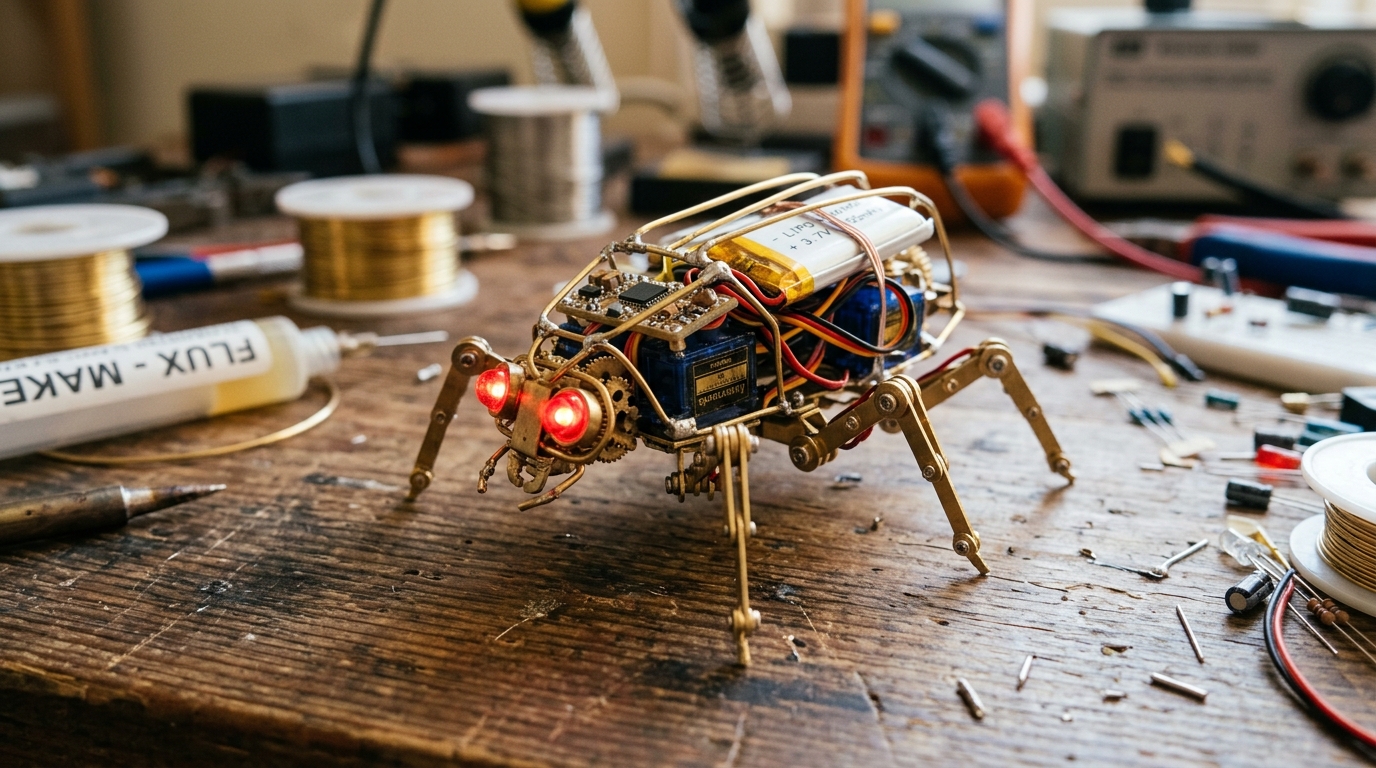
Workshop 1: Autonomous Insect Robotics with Fabienne
In the electronics lab, workshop leader Fabienne guided a diverse cohort of makers through the creation of small, autonomous insect-like robots. Drawing inspiration from Mark Tilden's pioneering BEAM robotics philosophy (Biology, Electronics, Aesthetics, and Mechanics), the workshop eschewed expensive microcontrollers and complex programming code in favor of elegant analog neuromorphic circuitry.
Participants constructed "vibrobots" and light-seeking "photovores" using basic electronic discrete components:
- Vibrational Locomotion: Miniature high-RPM pager vibration motors mounted onto angled copper wire legs or recycled toothbrush bristle heads, converting rotational kinetic energy into lifelike, organic crawling locomotion.
- Phototropic Neural Circuits: Matched pairs of cadmium sulfide (CdS) photoresistors wired to simple NPN transistor pairs in an H-bridge configuration. When ambient light struck one side of the robot, the corresponding motor sped up, steering the mechanical insect toward light sources in lifelike phototactic pursuit.
- Scavenged Power Systems: Small solar cells salvaged from discarded garden lights paired with high-capacity electrolytic capacitors, allowing the mechanical organisms to "feed" under workshop desk lamps and scurry across worktables in spontaneous bursts of energy.
By demystifying transistor switching and autonomous feedback loops without writing a single line of C code, the workshop demonstrated that robotics is fundamentally about physical systems design and behavioral feedback loops rather than costly computing hardware.
Workshop 2: Artisanal Wooden Luminaires with Julian
Simultaneously in the adjacent carpentry shop, Julian led a masterclass in architectural lighting design. The challenge: fabricate a contemporary, high-end desk luminaire using exclusively untreated timber slats, basic fasteners, and electrical fittings sourced from local building supply centers.
The curriculum emphasized both structural joinery and electrical safety:
- Material Economy: Transforming humble pine and oak offcuts into balanced cantilevered armatures through precise hand-sawing, lap joints, and counterweighted pivot hinges.
- Thermal and Electrical Safety: Wiring porcelain and Bakelite E27 lamp sockets with vintage textile-sheathed cords, integrating inline toggle switches, and ensuring strain relief to prevent electrical shorts.
- Light Modulation: Designing geometric shade diffusers from frosted acrylic sheets and Japanese washi paper, diffusing harsh bulb filaments into warm, ambient reading glows.
Participants walked away not merely with a finished desk lamp, but with a foundational mastery of joinery physics, electrical wiring, and the realization that bespoke interior decor does not require mass-market manufacturing.
Comparative Evaluation: Maker Prototyping vs. Mass Manufacturing
The philosophy championed at DIYDA presents a distinct contrast with conventional industrial product cycles. The table below delineates the operational differences between grassroots community fabrication and centralized mass production.
| Dimension | Grassroots Maker Fabrication (DingFabrik) | Conventional Mass Manufacturing | Cultural & Educational Impact |
|---|---|---|---|
| Tooling & Capital Cost | Near zero; hand tools, open-source 3D printers, off-the-shelf fasteners. | Extremely high; injection molds, CNC tooling, automated assembly lines. | Lowers entry barrier; empowers individuals and students to build immediately. |
| Design Iteration Cycle | Rapid, experiential; physical changes tested and altered in minutes. | Rigid; 6 to 18 months tooling lead times before production runs. | Fosters intuitive engineering problem-solving through immediate tactile feedback. |
| Material Sourcing | Hyper-local, upcycled cardboard, scrap timber, salvaged electronics. | Global supply chains, virgin polymers, outsourced international logistics. | Promotes ecological consciousness and repairability over planned obsolescence. |
| Customization & Agency | Every artifact is unique, adapted to the builder's exact ergonomic needs. | Homogeneous; standardized units designed for universal lowest-common denominator. | Cultivates deep psychological ownership and pride of craftsmanship. |
| Knowledge Sharing | Open-source documentation, Creative Commons licenses, peer mentoring. | Proprietary intellectual property, non-disclosure agreements, trade secrets. | Builds resilient community repositories of technical and craft knowledge. |
The Finissage Celebration at JACK IN THE BOX
As evening fell across Cologne, the workshops concluded and the entire community migrated to JACK IN THE BOX—a legendary cultural venue and former railway freight depot in the industrial heart of Cologne-Ehrenfeld. Accompanied by live indie performances, the buzz of conversation, and cold Kölsch beer, the official DIYDA finissage opened to an eclectic crowd of artists, architects, engineers, and neighborhood residents.
The centerpiece of the exhibition was a breathtaking series of monumental sculptures created primarily from corrugated cardboard and upcycled industrial paper packaging. Created in collaboration with artists such as Jonathan Haehn, these architectural installations ranged from delicate miniature paper geometries to towering, multi-meter-tall walk-in pneumatic structures. Illuminated from within by ambient warm light, the fibrous textures of the cardboard cast complex shadows across the raw brick and steel rafters of the industrial hall.
The finished insect robots buzzed across improvised obstacle courses on the concrete floor, delighting children and visiting designers alike, while the handmade wooden lamps cast warm pools of light over the exhibition tables. The event was not merely a retrospective exhibition; it was a living demonstration of collective creativity where the boundaries between fine art, architectural research, and garage electronics dissolved entirely.
Key Takeaways for Modern Creative Technologists
More than a decade after the 2010 Cologne gathering, the lessons of the DIYDA festival continue to illuminate best practices for creative technologists, physical computing designers, and interactive media engineers:
- Tactile Prototyping Informs Software Design: Software engineers who understand physical materials, analog signal constraints, and mechanical levers write better, more intuitive digital abstractions. Touching real hardware grounds conceptual problem-solving in tangible reality.
- Analog Simplicity Beats Over-Engineering: Fabienne's BEAM robots demonstrated that an autonomous machine does not always require an operating system, a Wi-Fi stack, or a microchip. Analog circuits with direct feedback loops are often more robust, energy-efficient, and elegant than software-bloated alternatives.
- Community Spaces Drive Innovation: Groundbreaking technical movements do not begin in corporate boardrooms; they germinate in chaotic, collaborative community workshops like DingFabrik where tools, ideas, and enthusiasm are freely exchanged without commercial pressure.
- Celebrate the Finished Artifact: The finissage serves as a vital reminder that engineering work is incomplete without public celebration. Exhibiting physical creations to real communities validates the maker journey, closes the learning loop, and inspires the next generation of creative builders.